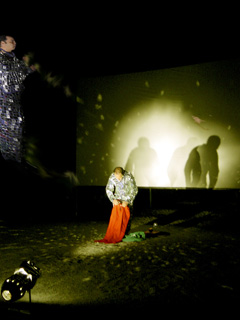
Miguel Benlloch (Loja, 1954 – Sevilla, 2018) va ser performer, poeta i activista polític i cultural. Durant les dècades de 1970 i 1980 va militar al Moviment Comunista d’Andalusia (MCA) i va promoure la creació del Front d’Alliberament Gai de Granada (FLGG) i del Front d’Alliberament Homosexual d’Andalusia (FLHA). L’any 1983 va fundar, juntament amb Juan Antonio Peinado i Marino Martín, la sala Planta Baja a Granada. De 1986 a 1994 va formar part del grup CUTRE CHOU, participant en els seus espectacles puntuals de cabaret. De 2001 a 2015 va coordinar i produir, amb l’equip de BNV Producciones, el programa arteypensamiento de la Universitat Internacional d’Andalusia (UNIA), a Sevilla, i va coordinar o codirigir els Seminaris de l’Arxiu Feminismes postidentitaris.
Miguel Benlloch duia a terme les seves accions generalment en interrelació amb l’àmbit en què era convidat a participar. Provocava discursos sobre la construcció de la identitat mitjançant l’ús de peces de roba que pertanyien tant a l’àmbit de la seva individualitat com de roba de treball que assenyalava espais col·lectius de producció, constituint pròtesis constructores de discurs. La concepció ritual dels processos de les seves accions delimitava un territori transcendent des del qual emergien símbols que es relacionaven amb l’espectador produint coneixement. La creença que la repetició és part constitutiva del ritual concebia la identitat com una construcció cultural i, per tant, deconstruïble i reritualitzable, en trànsit i reflexió permanents. La construcció del gènere, la construcció dels espais, la il·luminació com a enlluernament, la configuració de la subjectivitat en les geografies col·lectives són eixos rastrejables en les seves accions, on la música i la dansa precedeixen la veu.
Les seves performances/accions i obres s’han presentat en espais com The Kitchen (Nova York), Arteleku (Donostia/Sant Sebastià), el Centre Andalús d’Art Contemporani (Sevilla), el Museu d’Art Contemporani de Barcelona (Barcelona), el Museu Picasso (Barcelona), Ex Teresa Arte Actual (Ciutat de Mèxic), el Museo Nacional de Arte i el Museo de Etnografía y Folklore (La Paz), Tabakalera. Centre Internacional de Cultura Contemporània (Donostia/Sant Sebastià), Moderna Museet (Estocolm), el Centre de Creació Contemporània d’Andalusia (Còrdova), la Sala Atín Aya (Sevilla), CentroCentro (Madrid), l’Hospital Real (Granada), l’Institut Valencià d’Art Modern (València), el Van Abbemuseum (Eindhoven), la Villa Arson (Niça), el Centre d’Arts Santa Mònica (Barcelona) i el Centre Andalús d’Art Contemporani (Sevilla). Algunes de les seves obres formen part de les col·leccions de l’Institut Valencià d’Art Modern, el Museo Nacional Centro de Arte Reina Sofía, el Museu d’Art Contemporani de Barcelona i el Centre Andalús d’Art Contemporani (Sevilla), entre d’altres.
L’Arxiu Miguel Benlloch contribueix a mantenir viu el seu llegat creatiu per llegir i entendre el desenvolupament de l’art i de l’activisme estètic, polític i social a l’Estat espanyol del canvi de segle, que va situar al centre dels discursos el debat i el qüestionament de les categories binàries i heterocentrades.